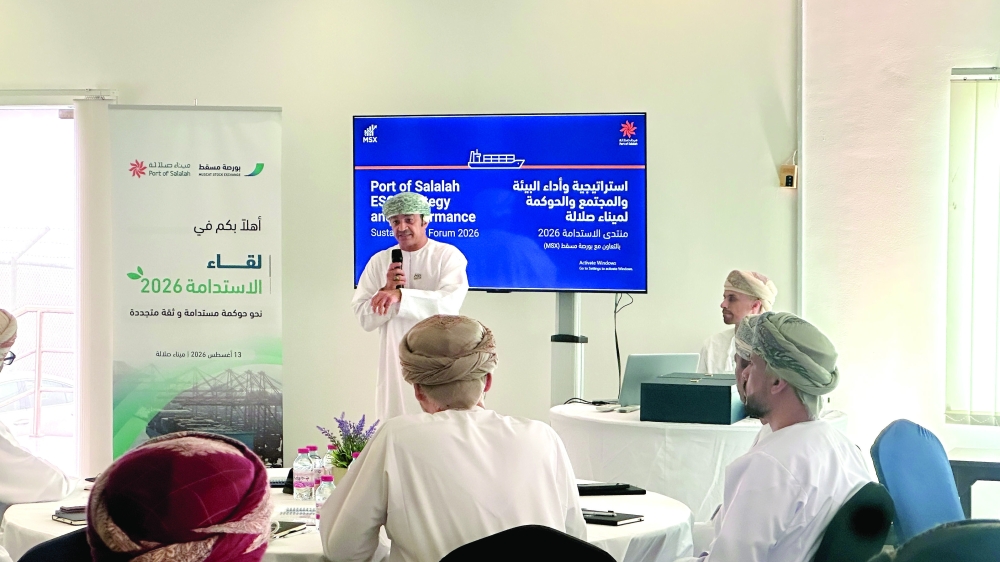





SALALAH: Companies should move beyond one-off sponsorships and consider jointly establishing a waqf institution to create a lasting source of community funding, the Chairman of Dhofar Municipality has said.
Dr Ahmed bin Mohsen al Ghassani made the proposal during the Sustainability Forum 2026, organised by Muscat Stock Exchange (MSX) and hosted by the Port of Salalah.
“Many companies wait until an organisation approaches them for sponsorship. They have a sponsorship budget, pay an amount here and another there, and the matter ends there,” Al Ghassani said. “I regard this as a comfort zone. We need to move to another stage.” He called on companies to use existing sponsorship allocations to develop community initiatives that address identified social needs while also supporting their strategic objectives.
“How can we develop initiatives that respond to the community’s needs and, at the same time, to the objectives of these companies?” he asked.
Al Ghassani proposed a waqf institution as one possible mechanism for making corporate social spending more sustainable.
“One company could undertake to establish a waqf institution, or perhaps a group of companies could establish one together,” he said.
A waqf institution manages and invests endowed assets, directing the resulting returns towards defined community purposes. Such a model could shift part of corporate giving from repeated annual expenditure towards a lasting source of social funding.
The speakers did not announce a new institution, capital commitment or implementation timetable at the forum. The proposal remains an option for further discussion among companies and public authorities.
Haitham bin Salem al Salmi, chief executive of MSX, said the exchange already held disclosure data that could help policymakers determine how corporate social spending is directed.
MSX’s environmental, social and governance disclosure framework comprises 30 indicators. Twenty-nine are harmonised with other GCC exchanges, while MSX added an indicator covering corporate social responsibility and community investment.
Al Salmi said the additional indicator was introduced after questions arose following Cyclone Shaheen in 2021 about the amounts allocated to social responsibility by public joint-stock companies and companies affiliated with Oman Investment Authority.
He put the number of MSX-listed companies covered by the disclosures at 109, saying the information was now available to policymakers and the wider public.
“The figures are now available to everyone,” Al Salmi said. “Decision-makers — the Ministry of Finance, municipalities and governorates — can determine how these investments should be directed.” The discussion shifted attention from how much companies contribute to how those contributions are organised and deployed. Disclosure can establish what has been spent, but it does not by itself determine whether the spending addresses an agreed public priority or produces a lasting benefit.
Oman already has a legal framework for establishing waqf institutions. The published regulations require a bank certificate showing capital of at least RO100,000, a fixed headquarters in the Sultanate of Oman and articles of association consistent with the Waqf Law and its regulations.
Related provisions require a board of directors and place waqf institutions under financial auditing and ministry oversight. The framework also accommodates in-kind capital and provides for the management and investment of waqf assets.
A 2025 amendment to the executive regulations of the Income Tax Law added cash and in-kind donations to registered waqf institutions to the categories deductible when calculating taxable income. According to the Tax Authority, total qualifying donations may be deducted up to a ceiling of 5 per cent of gross taxable income for the tax year.
Sector-specific precedents already exist in Oman, including the Health Endowment Foundation, ATHAR, and the Endowment Foundation for Education Support, Siraj.
Al Ghassani’s proposal would bring the corporate sector into this model, potentially combining company resources, MSX disclosure data and public development priorities.
The central question is whether existing corporate allocations can be coordinated and converted from annual spending into social assets capable of generating benefits over the longer term.
Oman Observer is now on the WhatsApp channel. Click here